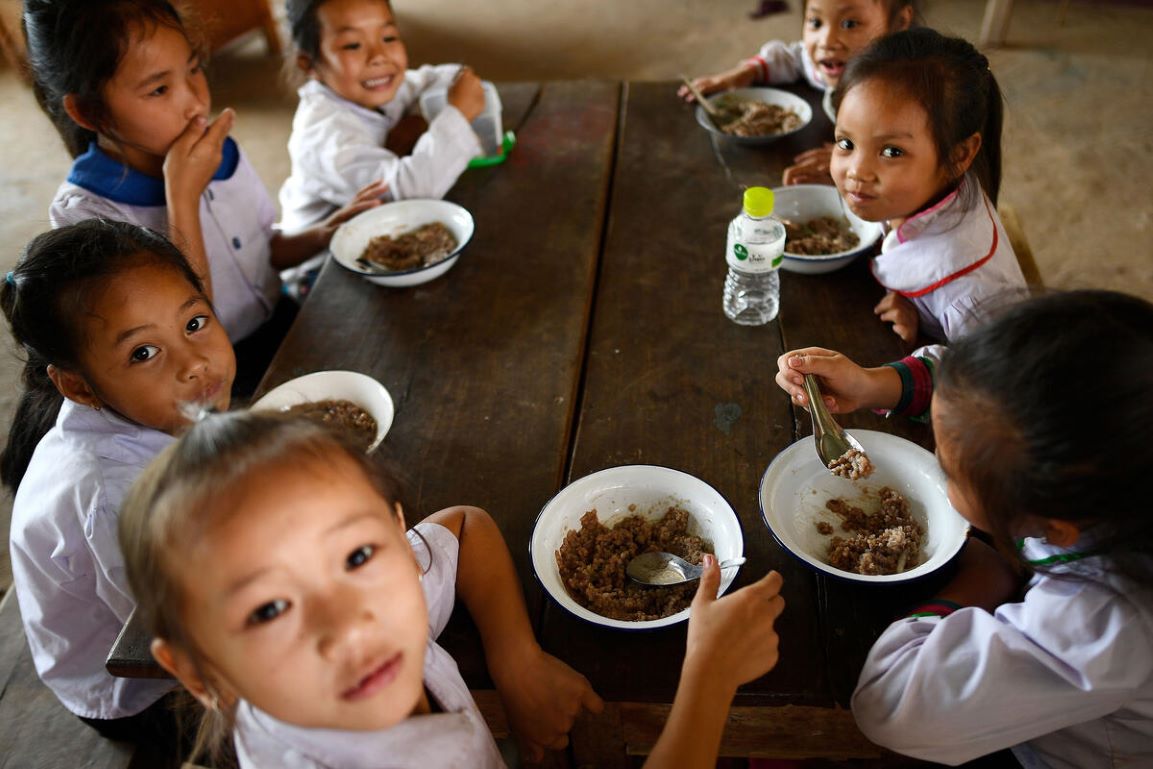
Hunger is falling across Southeast Asia. The region’s next challenge is more demanding: ensuring that everyone can afford a healthy diet, not merely enough calories to survive.
Southeast Asia’s hunger rate fell to 5.1% in 2025, its lowest level on record and down from the pandemic peak of 5.9% in 2020. About 35 million people faced hunger, roughly half the 70 million recorded in 2010. Over the same period, Southeast Asia’s share of the world’s hungry fell from about 11% to about 5%.
Moderate or severe food insecurity, which includes people forced to skip meals or reduce how much they eat, also declined. It fell to 12.8% in 2025 from a pandemic peak of 15.3%, meaning that 14 million fewer people faced food insecurity than in 2020.
This progress did not happen by accident. It reflects sustained investment in agricultural productivity, irrigation, logistics, food distribution and nutrition. Indonesia allocated about $8.8 billion (295.8 billion baht) to food security in 2025 and increased the allocation to nearly $12 billion in 2026. Vietnam paired its emergence as a major rice exporter with the achievement of national food security, showing that participation in international markets and domestic food access can reinforce one another.
The decline reaches across almost every country in the subregion. Since the mid 2000s, Cambodia has reduced its hunger rate from 15.5% to 4.7%. Indonesia brought its rate down from 18.4% to 6.3%; the Philippines from 17.3% to 3.4%; and Vietnam from 15.2% to 6.1%. Malaysia has reduced hunger below 2.5%.
These figures, from the 2026 edition of “The State of Food Security and Nutrition in the World”, show that hunger falls when agricultural, economic and social policies reinforce one another. Irrigation raises and stabilises production. Logistics connect farmers to markets. Trade creates opportunities for producers. Nutrition and social programmes protect vulnerable households.
There is no single Southeast Asian model that every country can copy. But there is a consistent lesson: deliberate investment in food systems can bend the hunger curve.
The progress, however, remains fragile and uneven.
Timor-Leste still has the highest hunger rate in the subregion, at 16.9%, even after reducing it from 28.8% since the mid-2000s. The larger divide is no longer only between those who have enough food and those who do not. It is between those who can afford to eat well and those who cannot.
Indonesia and the Philippines also have substantial ground to cover. About 68.6% of Indonesians and 45% of Filipinos cannot afford a healthy diet. Vietnam and Malaysia demonstrate that this outcome is not inevitable. Only 7% of people in Vietnam and 1.4% in Malaysia cannot afford one.
Southeast Asia has therefore made genuine progress against hunger measured through calorie deprivation. But obtaining enough calories is no longer the subregion’s only, or even its largest, food challenge.
A diet that prevents hunger does not necessarily prevent anemia, child stunting, obesity, diabetes and other forms of malnutrition. A genuinely healthy diet requires enough fruits, vegetables and animal source foods to provide the nutrients needed for an active and healthy life.
Such a diet costs an average of 5.19 purchasing power parity dollars per person per day in Southeast Asia, more than anywhere else in Asia and more than in most of the world. Nearly half of the subregion’s population, about 325 million people, still cannot afford one.
Calories have become more accessible. Nutrition remains expensive.
Closing the gap between calorie sufficiency and nutritional adequacy is Southeast Asia’s next challenge. It will require the same determination and sustained investment that helped close much of the hunger gap, but the target of that investment must now change.
Fruit is the food group contributing most to the high cost of a healthy diet in the subregion. Because fruit is perishable, its final price depends not only on what happens on farms but also on storage, refrigeration, transportation, energy, wholesale markets and retail distribution. Weaknesses at any point in that chain translate into losses and higher prices for consumers.
This is not simply a production problem. It is a midstream problem.
The response must therefore be more precise than producing more food or introducing broad new farm subsidies. Governments should invest in the supply chains that move nutritious food efficiently from farms to cities: cold storage, packhouses, rural roads, reliable energy, modern wholesale markets, processing capacity and competitive transportation.
Indonesia and Vietnam already possess much of the irrigation and logistics infrastructure that supported their progress against hunger. They are well positioned to extend that success to fruit, vegetables and other nutrient-rich foods. But the same investments must reach underserved regions, small-scale producers and lower-income consumers.
Sequencing also matters. Expanding school meals, food vouchers or other measures that increase demand before supply can respond may raise local prices and exclude the very households those policies are intended to support. Investment in production and supply chains must precede, or at least accompany, programmes that stimulate demand.
A decade ago, Cambodia, Indonesia, the Philippines and Vietnam might have appeared to be four unrelated success stories. We now know that their progress shared a common foundation: deliberate investment in irrigation, logistics and food systems capable of reaching large populations.
Making healthy diets affordable will require the same approach, directed this time towards the fruit and vegetable supply chains that keep nutritious foods expensive.
Southeast Asia has proved that it can reduce hunger. It must now prove that a healthy diet need not remain a privilege.
This article was first published in Bangkok Post on July 31, 2026.
(Photo by FAO/Manan Vatsyayana)

