With global chronic undernourishment now on a downward trend, the world is beginning to turn a corner in its fight against hunger. The UN’s newly released State of Food Security and Nutrition in the World 2025 reports that 673 million people (8.2 percent of the world’s population) were undernourished in 2024. This is down from 688 million in 2023. Although we have not yet returned to pre-pandemic levels (7.3 percent in 2018), this reversal marks a welcome shift from the sharp rise experienced during COVID-19.
India has played a decisive role in this global progress. The gains are the result of policy investments in food security and nutrition, increasingly driven by digital technology, smarter governance, and improved service delivery.
Revised estimates using the latest National Sample Survey data on household consumption show that the prevalence of undernourishment in India declined from 14.3 percent in 2020–22 to 12 percent in 2022–24. In absolute terms, this means 30 million fewer people living with hunger — an impressive achievement considering the scale of the population and the depth of disruption caused by the pandemic.

At the center of this progress is India’s Public Distribution System, which has undergone a profound transformation. Once notorious for corruption and inefficiencies, the system has been revitalized through digitalization, Aadhaar-enabled targeting, real-time inventory tracking, and biometric authentication. The rollout of electronic point-of-sale systems and the One Nation One Ration Card platform has made entitlements portable across the country, particularly crucial for internal migrants and vulnerable households.
These innovations allowed India to rapidly scale up food support during the pandemic and continue to ensure access to subsidized staples for more than 800 million people.
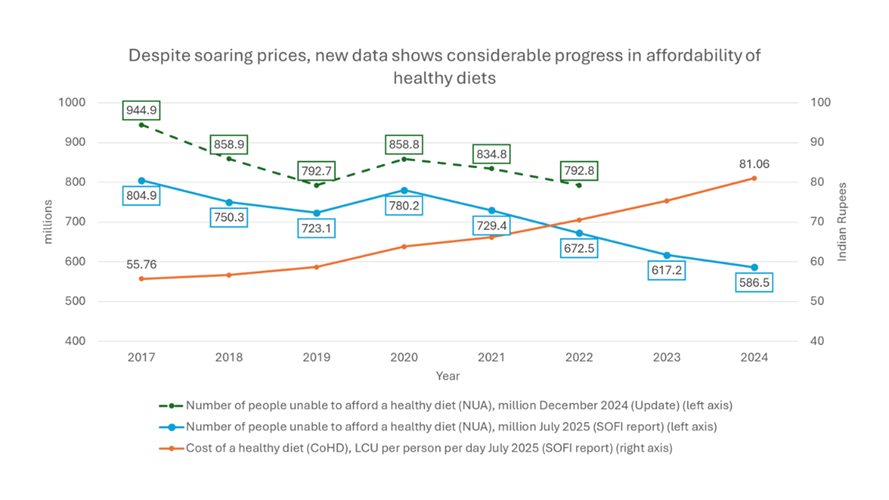
Now progress on calories must give way to progress on nutrition. The cost of a healthy diet in India remains unaffordable for over 40.4 percent of the population in 2024, driven by high prices of nutrient-dense foods, inadequate cold chains, and inefficient market linkages. That said, India has begun investing in improving the quality of calories. For example, the PM POSHAN school feeding scheme, launched in 2021, and the Integrated Child Development Services are now focusing on dietary diversity and nutrition sensitivity, laying the foundation for long-term improvements in child development and public health.
New data in the UN report also shows progress the country has made in making healthy diets more affordable despite food inflation.
What is happening underscores a larger structural challenge: even as hunger falls, malnutrition, obesity, and micronutrient deficiencies are rising. This is especially so among poor urban and rural populations.
India can meet this challenge by transforming its agrifood system. This means boosting the production and affordability of nutrient-rich foods such as pulses, fruits, vegetables, and animal-source products, which are often out of reach for low-income families. It also means investing in post-harvest infrastructure, like cold storage and digital logistics systems, to reduce the estimated 13 percent of food lost between farm and market. These losses directly affect food availability and affordability.
In addition, India should expand support for women-led food enterprises and local cooperatives, especially those cultivating climate-resilient crops, as these can enhance both nutrition and livelihoods.
And it must continue leveraging its digital advantage. Platforms such as AgriStack, e-NAM, and geospatial data tools can strengthen market access, improve agricultural planning, and enhance the delivery of nutrition-sensitive interventions.
These aren’t just national imperatives; they are global contributions. As a leader among developing countries, India is well-positioned to share its innovations in digital governance, social protection, and data-driven agriculture with others across the Global South. India’s experience shows that reducing hunger is not only possible, but that it can be scaled when backed by political will, smart investment, and inclusion.
With just five years left to meet the Sustainable Development Goals, including SDG 2 on ending hunger, India’s recent performance gives me hope. But sustaining this momentum will require a shift from delivering sustenance to delivering nutrition, resilience, and opportunity.
The hunger clock is ticking. India is no longer just feeding itself. The path to ending global hunger runs through India, and its continued leadership is essential to getting us there.
A version of this article was published in The Hindu on August 19, 2025.
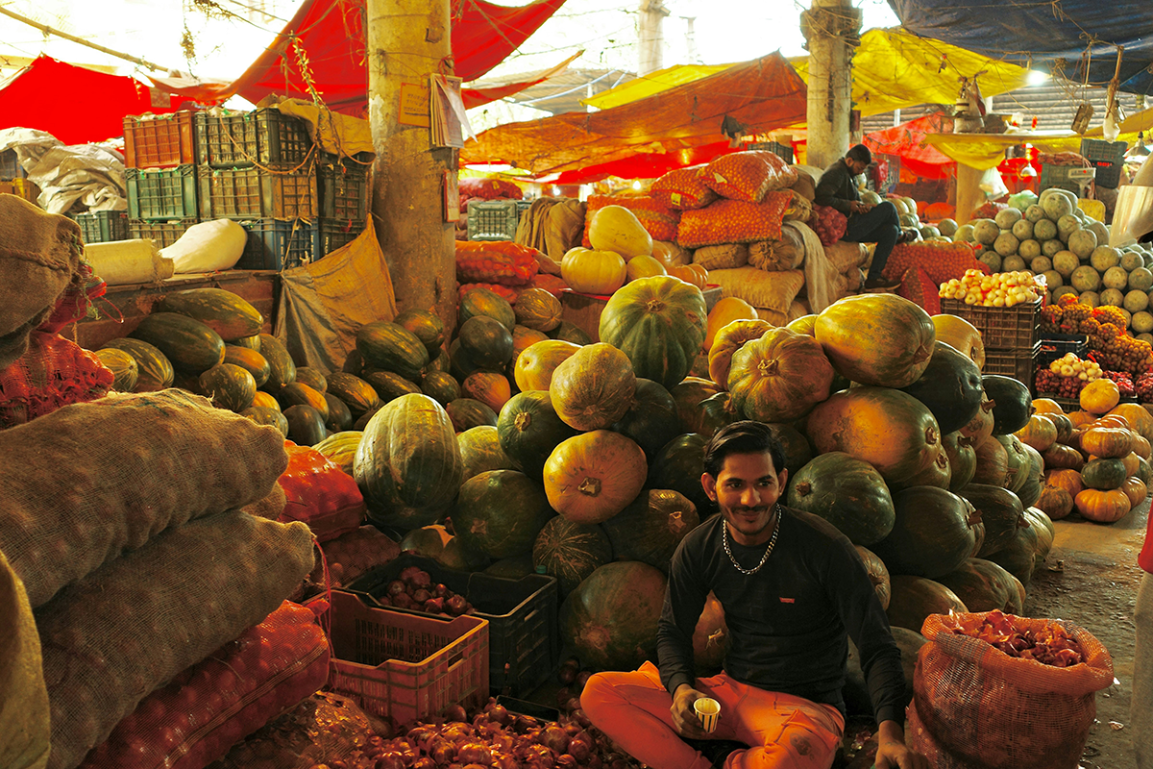
(Photo by ayush kumar on Unsplash)
 Maximo Torero